 Matt Roberts
Writing · No. 7 ·
Measure apart, fall apart
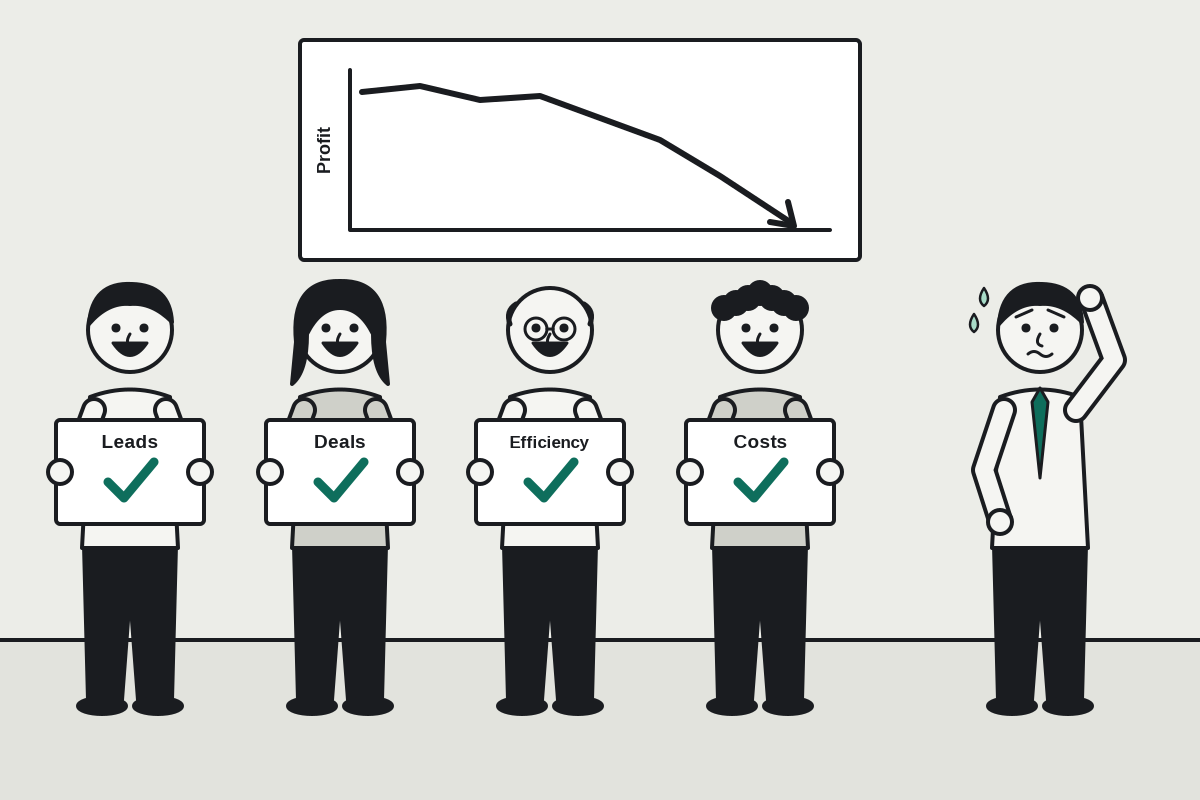
People chase what they're measured on, and they're very good at it. Give every team its own number, and each one will find the quickest way to hit it, even when that makes life harder for the team next door.
Marketing hits its lead target with leads sales can't close. Sales hits its number by signing customers who were never a good fit. Delivery keeps its efficiency figures up by cutting corners those customers notice. Finance squeezes costs that turn out to have been holding service together. Every dashboard is green, and the business is quietly going red.
Why good numbers go bad
The economist Charles Goodhart spotted the pattern decades ago. It's usually paraphrased as: when a measure becomes a target, it stops being a good measure. People don't cheat. They just find the easiest route to the number, and the easiest route is rarely the one that helps the customer.
Call centres measured on call length learn to end calls early. Support teams measured on tickets closed learn to close them without fixing anything. You'll have your own examples.
What to do instead
Share at least one number across teams. Pick one result the whole business is judged on, which no single team can hit alone. Orders delivered on time and at margin needs sales, operations and finance pulling together. So does profit per customer after twelve months. Once a number is shared, the handoffs between teams stop being somebody else's problem.
Give every number a partner. Speed with quality. Volume with margin. New customers with customers who stay. The partner stops the first number being hit in a way that hurts the business.
Keep it to a few. A team watching thirty numbers is really watching none. Three or four, looked at every week, beat a dashboard nobody reads.
Shared numbers come with one risk: if everyone owns a result, it can drift back to nobody owning it. So keep one named owner for the shared number, and let each team keep the two or three numbers it controls that feed into it.
Why this matters more with AI
AI tools will chase whatever number you point them at, faster and more literally than any person. Aim one at the wrong measure and it'll hit it brilliantly while doing damage you didn't think to measure. Choosing the right numbers is becoming a bigger part of a leader's job, not a smaller one.
Before your next planning round
List each team's main number. Next to each, ask the question that matters: could this team hit its number while the business loses? Wherever the answer is yes, you've found a silo.
Then agree one shared number, give each team number a partner, and put the shared one at the top of your weekly check. Watch how the conversation between teams changes once they're all looking at the same thing.
Measure apart, fall apart.
If every team's dashboard is green while the business isn't, choosing the shared numbers that pull your teams together is one of the changes we'd work on with you to get the numbers moving.