 Matt Roberts
Writing · No. 4 ·
Think it or know it?
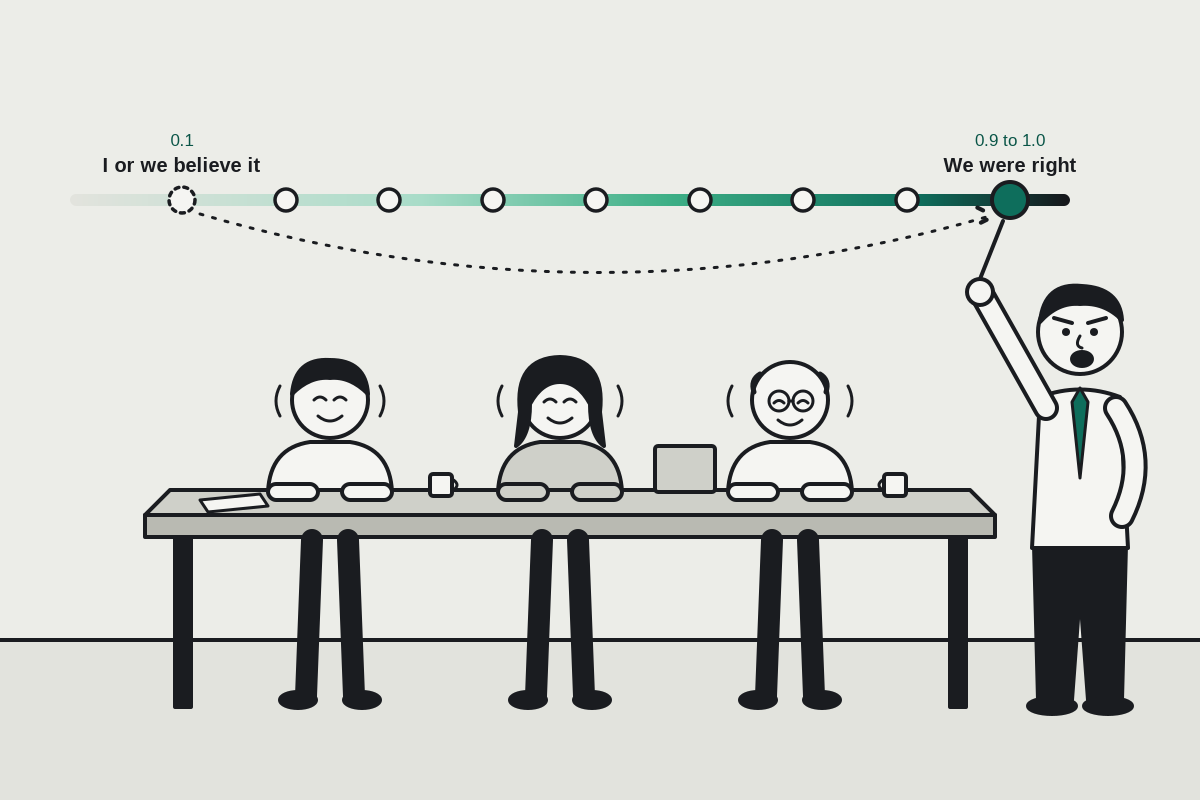
There's a question I ask so often that clients start asking it before I do. Someone in a leadership meeting says "customers want X" or "the problem is our pricing", and I ask: do we think it, or do we know it?
Most of what gets said in leadership meetings is thinking, and that's fine. The trouble starts when a guess gets repeated often enough to sound like a fact, and then it gets a budget.
Good ideas turn out wrong far more often than we'd like. Microsoft, which tests its ideas on real users more carefully than almost anyone, found that only about a third of them improved what they were meant to improve. That comes from Ron Kohavi, who ran experimentation there. If teams with that much data are wrong two times in three, a leadership team running on instinct is guessing more than it realises.
When a business is stuck, there's usually a room full of reasonable theories. Each has a champion. Nobody can prove theirs, so the loudest or most senior one wins, and the quarters go by.
Turn a theory into a test
Treat every theory as a bet you can check cheaply. For each one, write down:
- what you think is true
- the smallest thing you could try that would tell you if you're right
- the number you'll look at
- the date you'll decide
- what would make you stop
The last one matters most. Write the stop before the start, while nobody's pride or money is tied up in it yet.
Most theories can be tested in weeks, not quarters: five customer calls, a new price for new customers only, a changed process in one team. The point is to find out before you spend real money.
Where AI helps
AI is excellent at the first draft of the test. Ask it to argue against your favourite theory, list what else could explain the numbers, and suggest the cheapest way to find out. It's a sparring partner with no interest in office politics.
It can't make the call to the customer, though, or notice the pause before someone says "yes, that's fine". The best evidence still comes from people.
At your next leadership meeting
At your next leadership meeting, list every reason anyone gives for why the numbers are off. Next to each, write T for think or K for know. Be strict: "everyone says so" is a T.
To be stricter still, score each one on my confidence scale. Low confidence: test before you fund it. High confidence: back it.
- 0.1I or we believe itGut feel, or a persuasive write-up, deck or story.
- 0.2Others agreeLeaders, colleagues or an expert like it, or it fits the strategy, a trend or what peers do.
- 0.3It adds upRough value and cost, a feasibility check, a timeline.
- 0.4Some people want itA few data points, a handful asking for it, one competitor doing it.
- 0.5The numbers agreeSurveys, benchmarks, industry data, a smoke test.
- 0.7Looks like we're rightLots of internal data, 20+ interviews, a prototype or process trial.
- 0.8We're probably rightA controlled pilot in one team, region, channel or site.
- 0.9 to 1.0We were rightDone at scale, and the results measured.
Then pick the T that would matter most if it turned out to be true, and design the smallest test you could run in the next two weeks. One test, one owner, one date.
Watch what happens to the meeting. People stop defending theories and start designing tests, which is a much better conversation to be in.
Think it or know it?
If your leadership team runs on theories rather than tests, building that experimentation habit is one of the changes we'd work on with you to get the numbers moving.