 Matt Roberts
Writing · No. 6 ·
Customers can't choose a difference they can't see
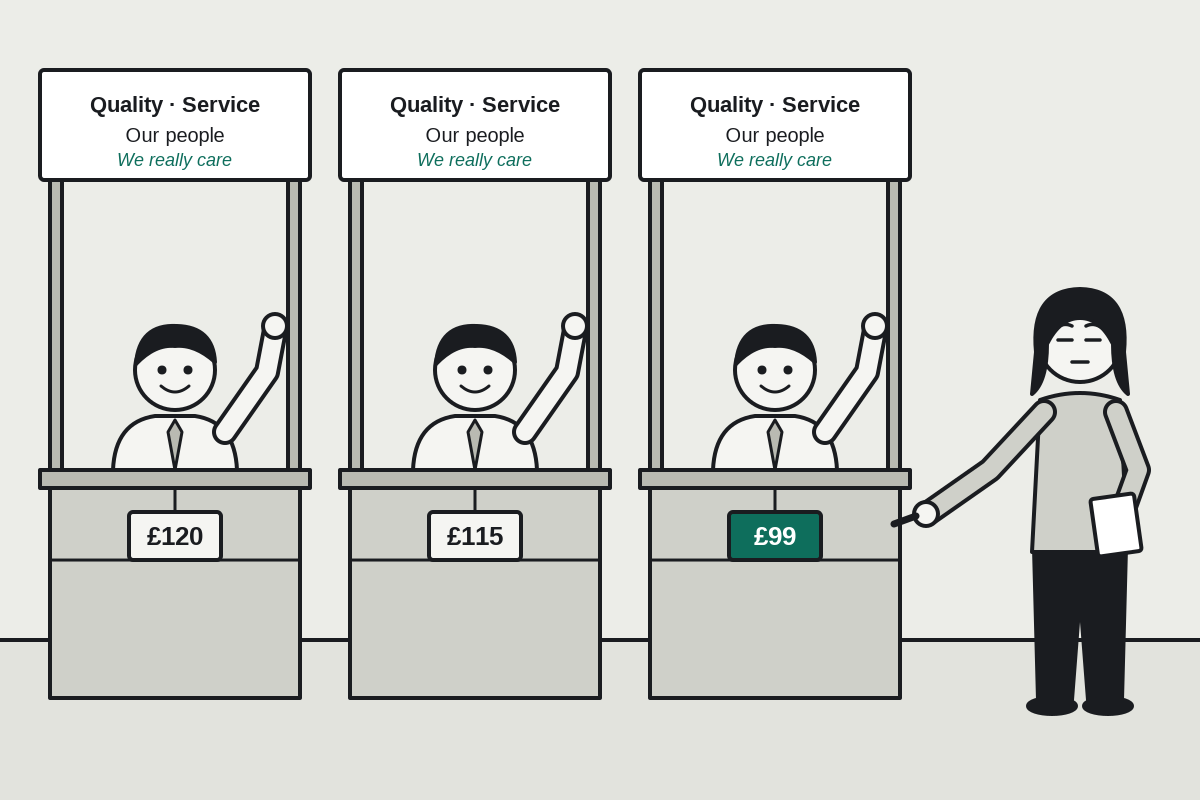
The trial lawyer Louis Nizer said it best: "If there is no difference, there is only indifference." I couldn't agree more, and I see the proof of it most weeks.
Ask a leadership team why customers choose them and you'll usually hear the same handful of answers: quality, service, our people, we really care. Every competitor says the same things, so to a customer none of them count as a reason. And when customers can't see a difference, they fall back on the one they can see, which is price.
Customers choose for more reasons than you think
People buy for a mix of logical and emotional reasons, and plenty of them have little to do with the product itself. These are some of the ones I work through with leadership teams:
- What they get: it meets their specific goals, unique features, a clever bundle
- Price and value: more for their money, payment or financing options
- Trust and risk: a recommendation, trusting the person selling it, reviews, a warranty, an easy returns policy
- Buying: an experience that delights, clear information, the easiest place to buy
- Delivery and after: speed, installation, after-sales service, being proactive, a community of other customers
The list matters less than the two questions you ask about each one.
Two questions for every reason
First, how much does this matter to your ideal customer? Must have, want, nice to have, or don't care.
Second, how do you compare with the competition? Best, the same, or not as good.
Put the answers side by side and the picture gets clear quickly:
- A must where you're best is your point of difference. Say it everywhere.
- A must where you're only the same is the price of entry. Nobody chooses you for it.
- A must where you're not as good is where you're losing customers, often without hearing why. Fix it first.
- A don't care where you're best may be money spent on something nobody notices.
The most common result is uncomfortable: not a single must-have where the business is clearly the best. That's why price keeps coming up in every sales conversation. It's also very fixable.
Choose where to be best
You can't be the best at everything, and trying is how businesses end up looking like everyone else. Pick no more than three reasons to be the best at. Choose them from the musts and wants, and favour the ones a competitor would struggle to copy. For everything else, match the market or let it go.
Then put it in one sentence:
For your ideal customer who need their must-haves, we're the best at your one to three reasons, and we can prove it because the evidence.
Before your next sales meeting
Score the reasons with your leadership team. It takes about 30 minutes, and "don't know" is a perfectly good answer.
Then do the part most teams skip, and ask five customers, including one you lost. Why did you choose us? What nearly stopped you? If we disappeared tomorrow, what would you do instead? Their answers will almost certainly change one of your scores, usually the one you were most sure about.
AI can give you a head start by reading your reviews, support emails and lost-deal notes and pulling out the reasons customers mention most. Treat that as a first pass. The calls are where you find out what really matters to the people paying you.
Customers can't choose a difference they can't see.
If your customers can't see why they should choose you, finding your point of difference and making it visible is one of the changes we'd work on with you to get the numbers moving.